How an IPO Works, and Why Some Anthropic Buyers Lost Money on Day One
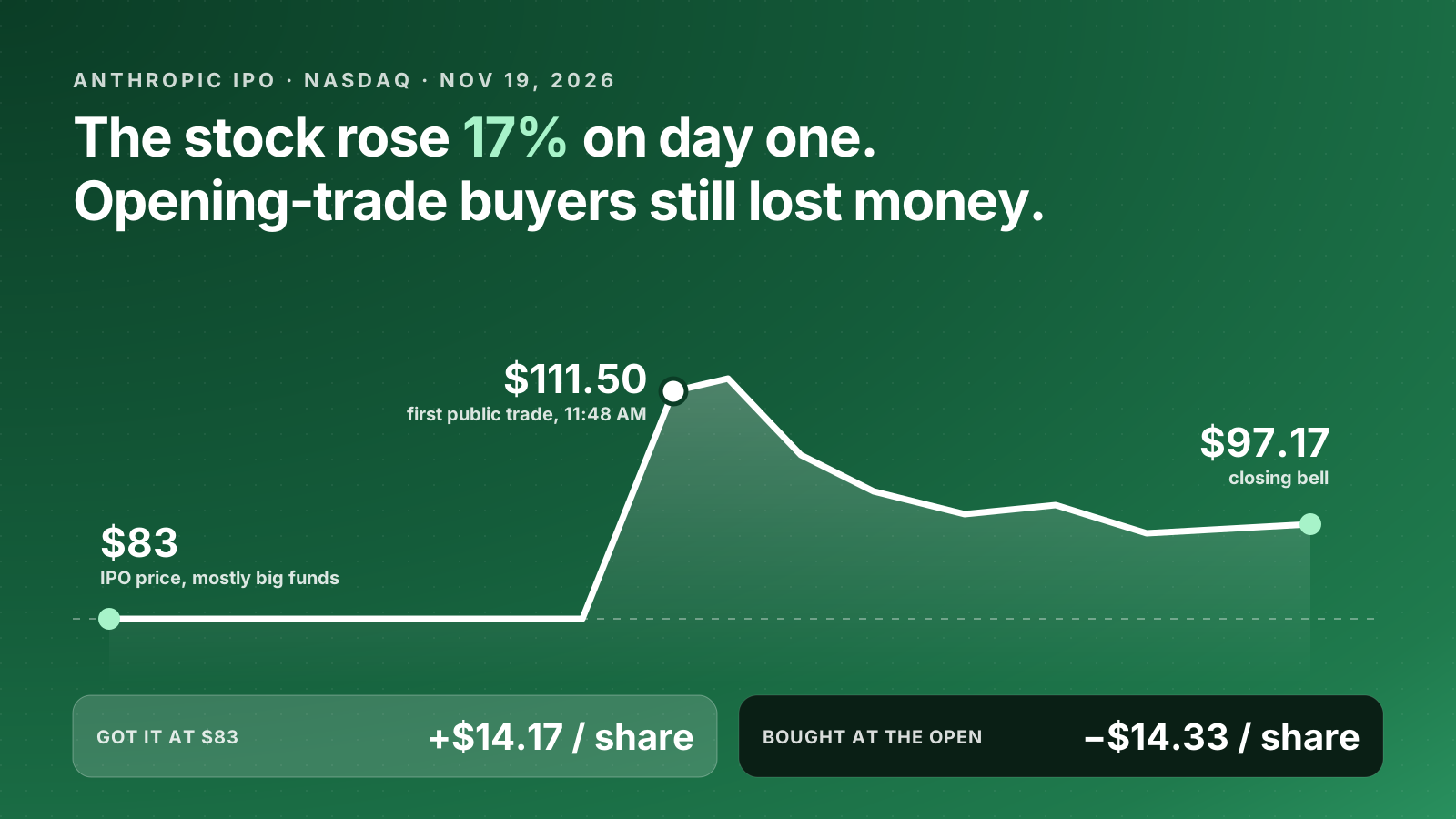
On Thursday, November 19, 2026, Anthropic, the company behind the AI assistant Claude, started trading on the Nasdaq under the ticker ANT. It was the largest IPO on record, raising about $81.3 billion.
The headlines said the stock rose 17% on its first day. But many people who bought that day were losing money by the closing bell.
Both things are true. To see why, you need to understand how an IPO actually works.
What is an IPO?
An IPO (initial public offering) is the moment a private company first sells shares to the public and lists them on a stock exchange. Before an IPO, ownership is mostly limited to founders, employees and private investors. After it, anyone with a brokerage account can buy and sell the shares.
Companies do it mainly to raise money to grow, and to give early owners a way to eventually sell their shares.
The two prices that confuse everyone
An IPO has two different prices, and the news usually reports only one of them.
1. The IPO price (set the night before)
The company and its banks decide the IPO price, also called the offer price, the evening before trading starts. They base it on how much demand they saw from big investors during the “roadshow,” a series of pitches to funds and institutions.
For Anthropic, the planned price range was $70 to $78 a share. Demand was so strong that the final IPO price was set higher, at $83.
The people who get shares at the IPO price are mostly large funds and institutions, plus a limited number of customers at some brokerages. Most everyday investors never get shares at this price.
2. The opening price (set by the market)
The next morning, the stock starts trading on the exchange. The opening price isn’t chosen by the company. It’s set by matching all the buy and sell orders waiting to go.
When a lot of people want in, the first trade can come in far above the IPO price. Anthropic’s first trade didn’t happen until about 11:48 a.m. Eastern, and it came in at $111.50, roughly 34% above the $83 IPO price.
What happened during the day
| Moment | Price | Compared to $83 IPO price |
|---|---|---|
| IPO price (set Nov. 18) | $83.00 | — |
| First trade | $111.50 | +34% |
| Day’s high | about $115 | about +39% |
| Day’s low | about $92.70 | about +12% |
| Closing price | $97.17 | +17% |
So here’s how two buyers ended the same day:
- Got shares at $83: up $14.17 a share, about +17%.
- Bought at the $111.50 opening trade: down $14.33 a share, about −13%.
Same company. Same day. Opposite results.
Why “the stock rose 17%” can be misleading
When the news says an IPO “jumped” on day one, it’s almost always measured from the IPO price, a price most regular investors never had a chance to pay. Your real starting point is whatever you pay once trading begins. On a hyped first day, that price is set by the most excited buyers in the market.
History has seen this before
A big first-day move doesn’t tell you where a stock goes next. A few well-known examples:
- Facebook (2012) ended its first day barely above its IPO price, then fell about 54% within its first six months as a public company.
- Uber (2019) closed its first day below its IPO price.
- Google (2004) rose about 18% on day one and went on to become one of the most valuable companies in the world.
The first day is one data point. It isn’t a prediction.
Three terms worth knowing
- Underwriters: the investment banks that help a company set its IPO price and sell the first shares.
- IPO pop: the jump from the IPO price to the first trading price.
- Lock-up period: a stretch of time, often several months, when insiders and early investors agree not to sell their shares. When lock-ups end, more shares can hit the market at once, which can affect the price.
The lesson
An IPO is really two events: a private sale at a set price, mostly to big investors, and then a public auction the next morning. Knowing the difference helps you read the headlines correctly.
The one-line lesson: A stock’s big debut can be a win for the people who got in early, and a trap for the people who got in excited.
Sources: Nasdaq trading data; CNBC, CNN, NBC News and Yahoo Finance coverage of Anthropic’s debut (Nov. 19, 2026); Trefis IPO history data.
About the author: Sharon writes The Paper Trail's plain-English money guides.
This article is general education, not personal financial advice. Everyone's situation is different. For decisions about your own money, consider speaking with a qualified professional.